
Not every career-support relationship works the same way.
Some people help you think through your next step. Some help you build confidence, sharpen your skills and make better decisions. Others use their influence to make sure your work is seen, your name is mentioned and the right opportunities reach you.
That is where the difference between mentorship and sponsorship matters.
A mentor supports someone’s growth through guidance, feedback and shared experience. A sponsor goes a step further by actively advocating for someone’s career advancement, often in rooms where that person is not present.
Both can play a powerful role in career development. But they are not the same thing, and treating them as interchangeable can limit their impact.
For organizations, understanding the difference between mentorship and sponsorship is not just a matter of terminology. It is a way to build clearer development pathways, create more equitable access to opportunities and support employees at different stages of their growth.
Mentor vs Sponsor: Key Differences
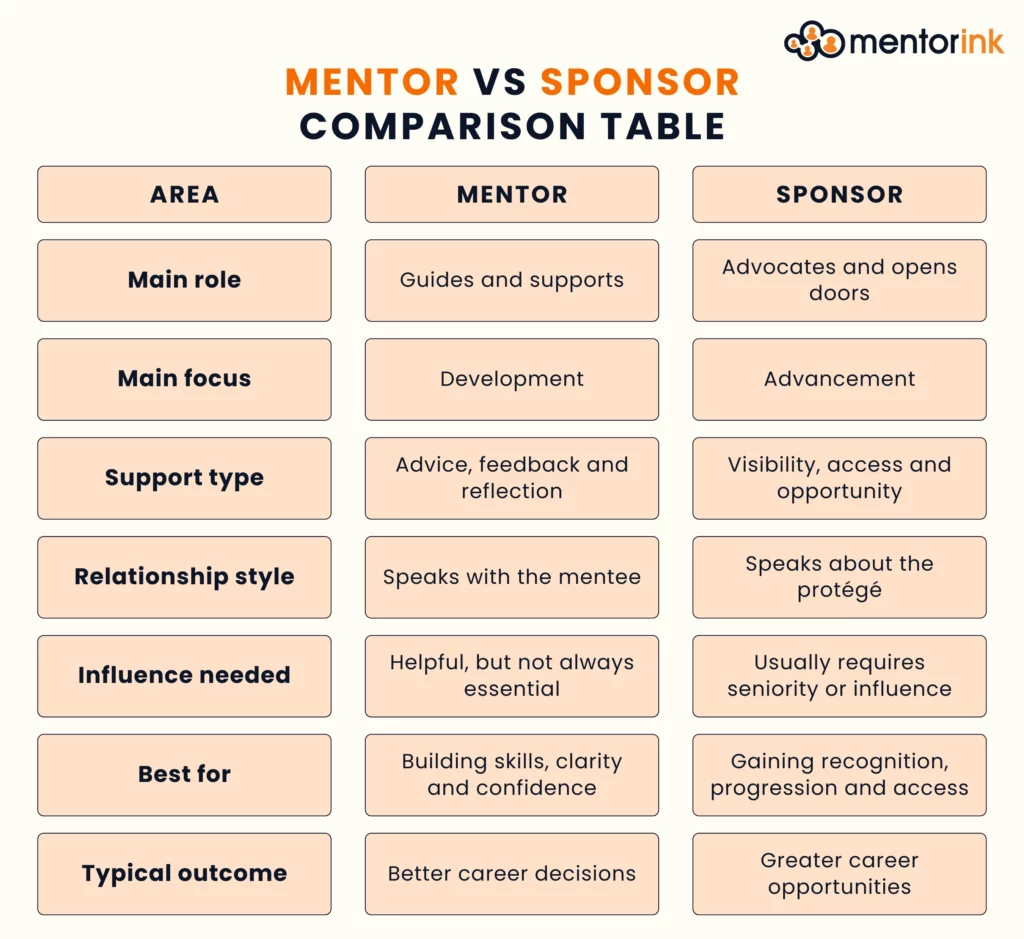
Mentors and sponsors are both important career supporters, but they do not support people in the same way.
A mentor usually helps someone develop from the inside out. They offer guidance, share experience, give feedback and help the mentee build confidence, clarity and skills.
A sponsor, on the other hand, helps someone advance by using their influence. They advocate for the person, create visibility and open doors to opportunities that may not have been accessible otherwise.
In simple terms, a mentor talks with you. A sponsor talks about you when it matters.
What Is a Mentor?
A mentor is someone who supports another person’s personal and professional development through advice, guidance and shared experience. In the workplace, mentors are often more experienced employees, managers or leaders, but mentoring does not always have to follow a strict senior-junior structure.
A mentor can help a mentee understand their strengths, navigate workplace challenges, improve specific skills, set goals and think more clearly about their career path. The relationship is usually built on trust, openness and regular conversation.
Mentors do not usually make career decisions on behalf of the mentee. Instead, they help the mentee become more prepared, confident and capable of making those decisions themselves.
To see how organizations can attract and retain the right mentors for their programs, check out our guide: Attracting and Retaining Mentors: A Practical Guide for Mentoring Program Managers.
What Is a Sponsor?
A sponsor is someone who actively advocates for another person’s career advancement. Sponsors are usually senior leaders or influential professionals who have the authority, visibility or network to create opportunities for the person they support.
While a mentor may help someone prepare for a promotion, a sponsor may recommend that person for the promotion. While a mentor may give advice before an important project, a sponsor may make sure the person is considered for that project in the first place.
Sponsorship often carries more risk than mentoring because the sponsor is putting their own reputation behind the person they support. This is why sponsorship usually requires a high level of trust, strong performance and confidence in the person’s potential.
Similarities Between Mentors and Sponsors
Although mentors and sponsors play different roles, both relationships are built around supporting career growth. They are different in practice, but they share a few important foundations:
- Both require trust. Whether someone is giving guidance or advocating for another person’s advancement, the relationship needs trust, openness and mutual respect.
- Both depend on belief in potential. Mentors and sponsors both need to see the person’s ability to grow, contribute and take on new challenges.
- Both support career development. A mentor may help someone build confidence, skills and clarity, while a sponsor may help connect that growth to real opportunities.
- Both can strengthen leadership development. Mentors help employees prepare for leadership. Sponsors help make sure ready employees are seen and considered for leadership opportunities.
- Both work better when organizations are intentional. When mentoring and sponsorship are left only to informal networks, access can be uneven. A more structured approach helps more employees benefit from the right support.
For organizations, the real value comes from understanding how these relationships work together. Mentoring helps employees grow. Sponsorship helps ensure that growth is recognized and connected to opportunity.
Mentorship vs Sponsorship: Key Differences
The difference between a mentor and a sponsor is about the role a person plays. The difference between mentorship and sponsorship is about how that relationship works in practice.
Mentorship is usually focused on development. It gives employees space to learn, reflect, ask questions, receive feedback and build the skills they need for long-term growth.
Sponsorship is usually focused on advancement. It helps employees gain visibility, access influential networks and be considered for opportunities that can move their careers forward.
Both can support career growth, but they solve different problems.
What Is Mentorship?
Mentorship is a development relationship where one person supports another through guidance, experience-sharing and ongoing conversation. In organizations, mentorship can happen informally, but it is often more effective when it is supported through a structured mentoring program.
A structured mentorship program helps employees connect with the right mentors based on their goals, interests, experience and development needs. This makes mentoring more accessible instead of leaving it only to people who already have strong internal networks.
Mentorship can support many different goals, from onboarding and leadership development to reverse mentoring, peer learning, diversity and inclusion, and career pathing. At its best, mentorship helps employees understand where they want to go and what they need to develop to get there.
What Is Sponsorship?
Sponsorship is a career-advancement relationship where an influential person actively advocates for another employee. Instead of only giving advice, a sponsor uses their credibility, network or decision-making power to create access to opportunities.
This might mean recommending someone for a promotion, putting their name forward for a high-visibility project, introducing them to senior leaders or making sure their achievements are recognized in important conversations.
Sponsorship often requires more trust and accountability than mentorship. A sponsor is not only supporting someone privately; they are publicly or strategically associating their own judgment with that person’s potential. That is why sponsorship often develops after a strong relationship, proven performance or clear evidence of readiness.
Why Organizations Need Both Mentoring and Sponsorship
Organizations need both mentorship and sponsorship because employees need both development and access.
- Mentorship builds readiness. It helps employees develop the skills, confidence and clarity they need before taking on new responsibilities.
- Sponsorship creates visibility. It helps employees become visible to senior leaders, decision-makers and people who can connect them with new opportunities.
- Mentorship helps people grow into opportunities. Through guidance and feedback, employees can better understand their strengths, development areas and career goals.
- Sponsorship helps opportunities reach the right people. Sponsors can advocate for employees in promotion discussions, leadership conversations or high-visibility project decisions.
- Mentorship without sponsorship can leave talent unseen. Employees may continue developing, but still miss out on advancement if their work is not visible to the right people.
- Sponsorship without mentorship can lack preparation. Employees may be pushed toward opportunities without enough guidance, confidence or support to succeed.
- Together, they make growth more equitable. When mentoring and sponsorship are left entirely to chance, opportunities often flow toward people who are already visible or well-connected. A more intentional approach helps organizations create fairer, clearer and more scalable career pathways.
Mentorship builds the foundation. Sponsorship creates momentum. Together, they help organizations support employee growth while strengthening leadership pipelines, engagement and retention.
Where Does Coaching Fit In?
Coaching is another form of development support, but it is different from both mentorship and sponsorship.
A coach usually helps someone improve a specific skill, behavior or performance area. Coaching is often more structured, goal-oriented and time-bound. For example, an employee might work with a coach to improve public speaking, leadership communication or conflict management.
Mentorship is usually broader and more relationship-based. Sponsorship is more focused on advocacy and access to opportunities.
In simple terms, coaching helps someone improve a specific capability, mentorship helps someone grow through guidance and sponsorship helps someone move forward through influence.
When Do You Need a Mentor, a Sponsor or Both?
Mentorship and sponsorship are not competing options. In many career journeys, people need both, but at different moments and for different reasons.
A mentor is especially valuable when someone needs guidance, perspective or development support. A sponsor becomes more important when someone is ready for greater visibility, responsibility or advancement, but needs advocacy to access the right opportunities.
Understanding when each relationship is most useful helps employees seek the right support and helps organizations design better development programs.
When Do You Need a Mentor?
You may need a mentor when you are still exploring your direction, building confidence or trying to make sense of your next step.
A mentor can be especially helpful when you are:
- Starting a new role, team or career path
- Building new skills or improving existing ones
- Looking for honest feedback and perspective
- Navigating workplace challenges
- Trying to understand your strengths and development areas
- Setting career goals
- Preparing for future leadership responsibilities
- Looking for a safe space to ask questions
Mentorship is most useful when the main need is learning, reflection and growth. A mentor may not make decisions for you, but they can help you become more prepared to make those decisions yourself.
When Do You Need a Sponsor?
You may need a sponsor when you have already built strong skills or performance, but need more visibility, access or advocacy.
A sponsor can be especially helpful when you are:
- Ready for a promotion or a stretch assignment
- Seeking access to senior leaders or decision-makers
- Doing strong work that is not being seen widely enough
- Looking for high-visibility projects
- Trying to move into a leadership role
- Facing barriers to informal networks or career opportunities
- Needing someone to advocate for you in rooms where you are not present
Sponsorship is most useful when the main need is opportunity. A sponsor does not simply give advice from the sidelines. They use their influence to help make sure the right people notice your potential.
Can a Mentor Also Be a Sponsor?
Yes, a mentor can become a sponsor, but it does not happen automatically.
A mentor may start by offering guidance, feedback and support. Over time, as trust grows and the mentor becomes more confident in the mentee’s abilities, they may begin to advocate for that person more actively. At that point, the relationship starts to move into sponsorship.
For example, a mentor might help an employee prepare for a leadership role by discussing their goals, strengths and development areas. A sponsor might go further and recommend that employee for the leadership opportunity when the decision is being made.
In simple terms, a mentor may help you prepare for the opportunity. A sponsor may help make sure the opportunity reaches you. Sometimes, one person can do both.
How Mentorink Supports Structured Mentoring Program
Mentorship and sponsorship can both create meaningful career growth, but they should not depend only on chance, personal networks or informal access.
This is where structured mentoring programs make a difference.
Mentorink helps organizations design and manage mentoring programs that are easier to scale, track and improve. Instead of relying on manual matching, scattered communication or unclear progress, organizations can create a more intentional mentoring experience for both mentors and mentees.
With Mentorink, HR and L&D teams can:
- Match mentors and mentees based on goals, skills, experience and development needs
- Support different mentoring formats, including one-to-one mentoring, group mentoring, peer mentoring and reverse mentoring
- Create structured mentoring journeys with clear expectations and milestones
- Track participation, engagement and progress throughout the program
- Reduce the administrative workload of running mentoring programs manually
- Make development opportunities more accessible across teams, locations and employee groups
While mentorship and sponsorship are not the same thing, strong mentoring programs can create the foundation for better sponsorship. When employees receive guidance, build confidence and develop trusted relationships with experienced colleagues, organizations are better positioned to recognize potential and connect people with future opportunities.
In other words, structured mentoring helps employees grow. It also gives organizations a clearer way to support, observe and develop talent at scale.
Final Thoughts
Mentorship and sponsorship are closely connected, but they are not interchangeable.
Mentorship helps employees develop the skills, confidence and clarity they need to grow. Sponsorship helps employees gain the visibility, access and advocacy they need to move forward.
A mentor can help someone understand their next step. A sponsor can help make sure that step becomes a real opportunity.
For organizations, the strongest approach is not choosing between mentorship and sponsorship. It is understanding how both can work together. When companies create structured development opportunities and make access to support more intentional, they can build stronger talent pipelines, improve employee growth and create fairer paths to advancement.
FAQs About Mentorship and Sponsorship
Is a sponsor better than a mentor?
A sponsor is not necessarily better than a mentor. They simply play a different role.
If someone needs guidance, feedback or support with their development, a mentor may be more useful. If someone is ready for advancement but lacks visibility or access to decision-makers, a sponsor may be more valuable.
In many cases, employees benefit from both.
Do organizations need both mentorship and sponsorship?
Yes. Organizations need both mentorship and sponsorship because they support different parts of career growth.
Mentorship helps employees develop. Sponsorship helps employees access opportunities. When both are present, organizations can support learning, improve visibility, strengthen leadership pipelines and create fairer pathways for career advancement.
How can companies create effective mentorship and sponsorship programs?
Companies can create more effective mentorship and sponsorship programs by being intentional. This means understanding employee needs, defining clear goals, matching people thoughtfully, setting expectations, providing guidance for participants and tracking outcomes.
For mentorship programs, structure is especially important. A structured mentoring program helps organizations make development more accessible, measurable and scalable instead of relying only on informal relationships.