
Every engineering team has that one person.
The one who knows why the system was built that way, which “temporary fix” became permanent and why everyone should be slightly afraid of touching that one part.
That is exactly why mentorship in engineering matters.
Because the most useful engineering knowledge does not always live in documentation. It lives in experience, in failed prototypes, design reviews, production issues and those tiny warnings that usually start with “just so you know…”
A strong engineering mentoring program helps organizations turn that experience into shared knowledge. It gives engineers a structured way to learn from others, ask better questions, build confidence and grow into stronger technical or leadership roles.
Mentoring in engineering does not replace technical training or formal career development. It makes the learning already happening inside engineering teams more intentional, accessible and much less dependent on luck.
Importance of Mentorship in Engineering
Engineering teams rarely struggle because people do not want to learn. More often, the problem is that the most useful knowledge is trapped in someone’s head, usually the person everyone secretly hopes will never go on holiday.
A senior engineer may know why a system behaves a certain way, which design decision still matters, or which small warning sign means a project is about to become everyone’s problem. But unless that knowledge is shared intentionally, it stays hidden inside individual experience.
That is where mentorship in engineering becomes valuable. It helps organizations turn practical experience into shared knowledge, supporting onboarding, technical confidence, leadership development, collaboration, innovation and retention before critical know-how becomes siloed or disappears completely.
Why Mentorship in Engineering Matters
In engineering, not everything that matters is written in a process guide. Some of the most useful lessons come from real situations: troubleshooting the same issue for the fifth time, explaining a technical decision to a non-technical stakeholder, managing risk, reviewing a design, or realizing why the “obvious” solution failed last time.
Mentorship in engineering helps this knowledge move from experienced engineers to those still building their technical judgment. It gives mentees space to ask questions they may not bring into a performance review, and gives mentors a way to pass on insight that would otherwise stay informal.
This matters even more in teams working with complex systems, fast-changing technologies, tight deadlines and high expectations for quality. Without structured mentoring, junior engineers rely on luck, new hires take longer to understand how things really work and future leaders may step into bigger roles without enough guidance. A successful engineering mentorship program helps reduce that risk.
How to Build a Successful Engineering Mentoring Program
A successful engineering mentoring program should fit the way engineering teams actually work. In other words, it should not collapse the first time a sprint gets intense, a release moves, a site issue appears, or someone says, “Can we quickly review this?” which usually means nothing will be quick.
To make the program realistic and useful, organizations should focus on:
- Start with an engineering-specific goal: Define whether the program is supporting onboarding, technical development, leadership readiness, internal mobility, innovation, retention, women in engineering, or knowledge transfer.
- Match around real engineering context: Do not match people only because their calendars look friendly. Consider technical expertise, engineering discipline, project type, seniority, career goals, product area, tools, location and development needs.
- Prepare mentors for meaningful conversations: Engineering mentors should know how to guide without taking over. The goal is not to solve every problem for the mentee, but to help them think more clearly, ask better questions and build stronger judgment.
- Separate mentoring from performance evaluation: Mentees should feel safe discussing uncertainty, mistakes, career doubts, technical gaps, or confidence issues. Mentoring should not feel like another meeting where someone is quietly scoring them.
- Make the structure realistic for engineering schedules: Long or frequent meetings may not work during intense project periods. Monthly check-ins, flexible scheduling, focused conversation prompts and clear expectations can help the relationship stay active.
- Give program managers visibility without over-controlling the relationship: HR, L&D and engineering leaders need to know whether mentoring relationships are active, but they should not enter private conversations. The goal is to track engagement, feedback and progress while protecting trust.
When these elements are in place, mentoring in engineering becomes more than informal advice. It becomes a reliable development practice that helps engineers grow while helping organizations protect the knowledge that keeps technical teams strong.
Benefits of Mentorship in Engineering
The benefits of mentorship in engineering are not just about helping people “grow.” That sounds nice, but engineering teams need more than nice. They need fewer repeated mistakes, faster ramp-up, better technical judgment and less “only Alex knows how this works” panic.
Benefits for Mentors in Engineering
For mentors, engineering mentorship turns hard-earned experience into wider impact. Key benefits include:
- Turning lessons learned the hard way into reusable insight: Mentors help others avoid the mistakes, blind spots and “we tried that already” moments they have already lived through.
- Becoming better technical translators: Explaining complex decisions to a mentee helps mentors sharpen how they communicate risk, trade-offs and constraints.
- Building influence beyond delivery: Mentors become known not only as people who solve problems, but as people who make other engineers stronger.
- Practicing leadership without becoming a manager: Mentoring gives senior engineers a way to develop coaching, feedback and guidance skills without leaving the technical track.
- Stress-testing their own thinking: When a mentee asks “why do we do it this way?”, mentors often have to separate real engineering logic from “because we always have.”
- Protecting the quality of the craft: Mentors help pass on engineering standards, judgment and habits that are difficult to capture in documentation.

Benefits for Mentees in Engineering
For mentees, mentorship in engineering provides access to the kind of practical guidance people usually get only after struggling alone for too long. Key benefits include:
- Learning the system behind the system: Mentees understand not only how something works, but why it was built that way and what not to touch casually.
- Making fewer avoidable mistakes: A mentor can help mentees spot risks earlier, ask better questions and avoid repeating problems the team has already solved.
- Building real technical judgment: Mentees learn how to balance speed, quality, safety, cost, scalability and maintainability in real decisions.
- Getting unstuck faster: Instead of losing days in silence, mentees have someone who can help them frame the problem and choose the next step.
- Communicating like an engineer people actually understand: Mentoring helps mentees explain risks, trade-offs and decisions without turning every update into a technical maze.
- Seeing possible career paths earlier: Mentees can explore technical specialist, engineering manager, product-facing, R&D, operations, quality, or architecture paths with more clarity.
Benefits for Organizations in Engineering
For organizations, mentoring in engineering helps reduce the hidden risks that slow technical teams down. Key benefits include:
- Less knowledge trapped in one person’s head: Critical context becomes easier to share before someone leaves, changes teams, or finally takes a holiday.
- Faster onboarding into complex systems: New engineers learn the real workflows, dependencies and unwritten rules faster.
- Fewer repeated technical mistakes: Teams can transfer lessons from past failures, design decisions and production issues more intentionally.
- Stronger engineering consistency: Mentoring helps spread better habits around documentation, reviews, risk thinking and decision-making.
- A healthier leadership pipeline: Future technical leads and engineering managers build judgment before they are suddenly responsible for people, priorities and problems.
- Better collaboration across functions: Mentoring can improve how engineering works with product, design, operations, quality, manufacturing, data, or customer-facing teams.
- Higher retention of technical talent: Engineers are more likely to stay when they feel supported, challenged and able to grow without being left to figure everything out alone.
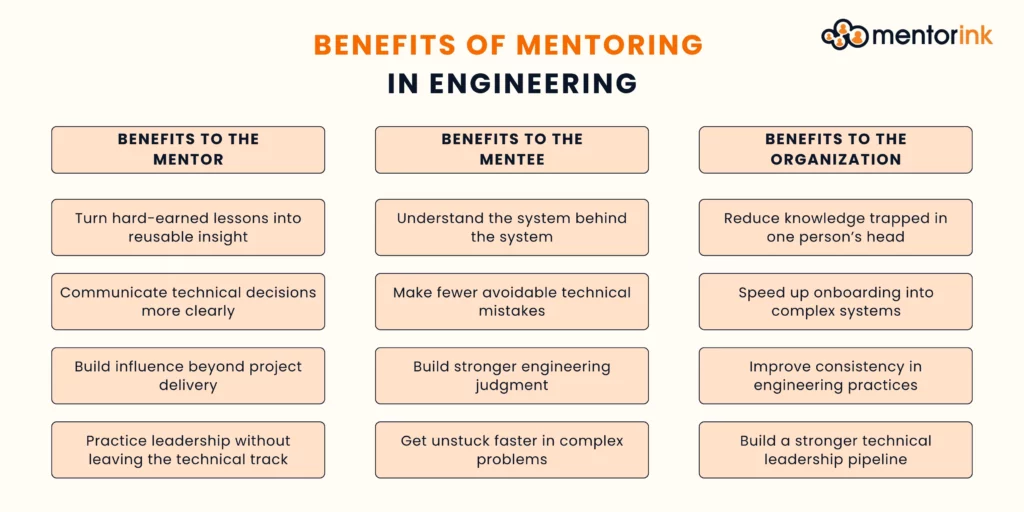
When these benefits come together, mentorship in engineering becomes more than a development initiative. It becomes a way to protect expertise, reduce technical risk and build stronger engineering teams over time.
The Value of Mentorship in Technology
Technology moves fast. New tools, AI systems, automation methods, cybersecurity expectations and product demands can make learning feel endless.
But in technology, people do not only need to learn what is new. They need to learn how to think through change.
That is the value of mentorship in technology. Mentoring in technology helps engineers and technical teams understand how to prioritize, make decisions, evaluate risks, collaborate across functions and apply new knowledge in real work.
This matters for software engineers, product engineers, data teams, infrastructure teams, technical support teams, R&D teams and engineering leaders. A tool can be learned from documentation. But knowing when to use it, what to question and how to explain the decision usually comes from experience.
In fast-moving technical environments, mentorship is not a slow or soft activity. It is a practical way to help people keep learning without leaving growth to chance.
Mentoring Models for Engineering Organizations
The right mentoring model depends on what the organization is trying to improve. Some teams need faster onboarding. Some need better knowledge transfer. Some need future engineering leaders. Others need stronger collaboration between technical and non-technical teams.
That is why mentoring in engineering should not start with “let’s match people and see what happens.” It should start with a clear need.
- Senior-to-junior mentoring works well when the goal is to help early-career engineers build technical confidence and learn from experienced professionals.
- Peer mentoring is useful when engineers at similar levels are facing shared challenges, such as adapting to a new role, learning a new technology, or moving into more responsibility.
- Leadership mentoring supports engineers who are preparing for team lead, engineering manager, or senior technical leadership roles. Cross-functional mentoring helps engineering work better with product, design, operations, quality, manufacturing, data, customer success, or business teams.
- Reverse mentoring can be useful when younger or more digitally fluent employees help senior colleagues understand new tools, AI, automation, or emerging ways of working.
- Project-based mentoring works best when the goal is tied to a specific technical challenge, such as a system migration, product launch, process improvement, or R&D initiative.
The strongest engineering mentorship programs do not use one model for every problem. They choose the model based on the type of support engineers actually need.
Example Mentoring Programs in Engineering
Once the model is clear, the next step is turning it into a focused program. These examples show how mentorship in engineering can be designed around specific business and team needs.
Junior Engineer Confidence Program
This program supports junior engineers or graduate hires during their first year. Instead of focusing only on general career advice, it helps them build confidence in asking technical questions, joining reviews, understanding design decisions and speaking up when something is unclear.
Critical Systems Knowledge Transfer Program
This program pairs experienced engineers with team members who need to understand complex systems, legacy architecture, internal tools, safety-critical processes, or long-running product decisions. The goal is to reduce dependency on a few people who hold too much technical context.
Engineering Manager Readiness Program
This program supports engineers who may soon move into team lead or engineering manager roles. It focuses on prioritization, feedback conversations, stakeholder management, team communication and the shift from solving problems directly to helping others solve them well.
Cross-Functional Product Delivery Program
This program connects engineers with people from product, design, operations, quality, data, customer success, or manufacturing. It helps teams understand each other’s constraints earlier, reduce miscommunication and make better decisions across the product lifecycle.
Innovation and R&D Mentoring Program
This program supports engineers working on new ideas, experiments, prototypes, AI initiatives, automation projects, or emerging technologies. The focus is not only technical creativity, but also risk evaluation, learning from failure and turning experiments into usable outcomes.
Women in Engineering Growth Program
This program supports women engineers with career progression, visibility, confidence, leadership development and access to guidance. It can be especially valuable in organizations that want to improve retention and make growth opportunities more visible and equitable.
The difference is simple: mentoring models define the format, while mentoring programs define the purpose. Engineering teams need both.
Tips for Mentorship Success in Engineering
The best tips for mentorship success in engineering are not about adding more structure for the sake of structure. Engineers already have enough systems, tickets, reviews and meetings trying to become meetings about meetings.
What makes engineering mentorship work is making each conversation useful, specific and connected to real work.
- Build the habit before the crisis: Mentoring should not only happen when someone is completely stuck. Regular conversations help engineers learn earlier, not just recover later.
- Bring real engineering problems: Mentees should come with actual situations, such as a design trade-off, debugging challenge, stakeholder concern, project handover, or technical decision.
- Do not turn every session into problem-solving mode: Mentors should guide the thinking, not immediately take over the issue. The goal is better judgment, not dependency.
- Talk about failed decisions, not only success stories: Delayed releases, broken assumptions, failed prototypes and messy handovers often teach more than perfect case studies.
- Use mentoring to explain the “why”: A mentor can help a mentee understand why a system was built a certain way, why a process exists, or why a shortcut may become expensive later.
- Keep the conversation focused: One strong discussion about a technical decision, communication challenge, leadership moment, or career path is better than a vague catch-up.
- Make space for uncertainty: Mentees should be able to say “I do not understand this yet” without feeling like they are failing.
- Connect learning to the next action: Every session should end with something practical: a question to ask, a decision to revisit, a risk to clarify, or a next step to try.

How Mentorink Can Support Engineering Mentoring Programs
In engineering, the problem is usually not whether mentoring is valuable. It is whether the right people are matched, the program stays active and the knowledge actually moves beyond a few senior engineers.
Mentorink helps engineering organizations manage that more clearly.
With Mentorink, teams can match mentors and mentees based on technical expertise, goals, career stage, department, location, or development needs. Program managers can run different tracks for onboarding, technical growth, leadership, women in engineering, innovation, or knowledge transfer without managing everything manually.
Mentorink also gives teams visibility into participation, feedback and engagement, without entering private mentoring conversations.
So mentorship in engineering does not stay as informal “ask someone if you know who to ask” support. It becomes a more structured, trackable and scalable way to help engineers learn from experience.
Engineering Mentoring Program Examples from Mentorink Customers
At Mentorink, we see engineering and technology teams use mentoring in different ways depending on their goals. Some programs focus on technical depth, while others focus on innovation, digital transformation, leadership, or supporting women in technology.
For example, some customers run technical mentoring programs where experienced mentors share their expertise in specific areas and help mentees deepen their knowledge through a structured development process. These programs are especially useful when organizations want to transfer specialized know-how, support technical confidence and help employees learn from people who have already worked through similar challenges.
Some customers also run technology and innovation focused mentoring programs. These programs help employees explore new technologies, develop innovation skills and take a more active role in digital transformation. They are often designed for people who want to contribute more creatively to technology-driven change inside the organization.
We also see mentoring programs focused on women in technology and innovation. These programs support women as they build confidence, strengthen leadership skills, increase visibility and take more active roles in technical and innovation-focused career paths.
These examples show why engineering mentoring should not be treated as one fixed format. With Mentorink, organizations can shape mentoring around the real development needs of their people, whether the focus is technical expertise, innovation, leadership, knowledge transfer, or career progression.
Engineering Mentoring Program FAQs
How should mentors and mentees be matched in an engineering mentoring program?
Mentors and mentees should be matched based on more than job title or availability. A strong match considers technical expertise, engineering discipline, career goals, project experience, seniority, location and development needs.
For example, a junior software engineer may need support from someone who understands a specific codebase or product area. A future engineering manager may need a mentor with leadership experience. A new hire may benefit from someone who understands internal systems and team culture.
How can mentoring work when engineers have busy project schedules?
Mentoring in engineering works best when the structure is realistic. Instead of requiring long or frequent meetings, organizations can use monthly check-ins, flexible scheduling, focused prompts and clear expectations.
The goal is not to add another heavy process. It is to create a useful development rhythm that can survive sprint cycles, project deadlines, design reviews, releases, site work, or production issues.
Should engineering mentoring focus on technical skills, leadership, or career development?
It can focus on any of these, but the goal should be clear from the beginning.
Some programs are designed to build technical confidence. Others focus on leadership readiness, onboarding, knowledge transfer, inclusion, innovation, or cross-functional collaboration. The strongest engineering mentorship programs define the purpose first, then design the matching, structure and success measures around that purpose.
How can organizations measure the success of an engineering mentoring program?
Organizations can track participation, meeting activity, feedback, goal progress, retention signals, onboarding experience and participant satisfaction.
For engineering teams, it can also be useful to look at whether mentees feel more confident, whether new hires adapt faster, whether knowledge is being shared across teams and whether future leaders feel better prepared. The key is to measure program health without turning mentoring conversations into performance evaluations.
How can mentoring support junior engineers without becoming performance evaluation?
Mentoring should be positioned as a safe development space, not a performance review. Mentors should guide, ask questions, share experience and help mentees reflect, but they should not act as assessors.
Clear boundaries are important. Mentees should know that they can discuss uncertainty, mistakes, technical gaps, or career concerns without fear of judgment. Program managers can track engagement and feedback, but private mentoring conversations should remain private.
Conclusion
Engineering knowledge is not built only through documentation, training, or perfectly organized folders that everyone promises to update someday.
It is built through experience. Through design decisions, production issues, failed attempts, technical trade-offs and the people who know why something works the way it does.
As engineering and technology teams face faster change, more complex systems and higher expectations, mentoring becomes a practical way to help people grow without leaving development to luck.
With the right structure, mentoring in engineering can become more than informal support. It can become a visible, scalable way to build stronger engineers, stronger teams and stronger technical capability over time.