You’ve launched your mentoring program, manually.
You went through spreadsheets, reviewed profiles, and tried to make the best possible matches. It took time, effort, and a lot of coordination, but you made it work. People are paired, the program has started, and on the surface, everything looks fine.
But then the real questions begin.
Did you actually match the right people?
What happens if some pairs don’t click?
How will you remind participants to meet regularly?
What will you do when engagement starts to drop?
This is where things start to feel less clear. Not at the launch stage, but a few weeks in, when keeping the program active becomes more challenging than starting it. If you want a broader overview of mentoring programs and how they work, you can check out our Ultimate Guide to Mentoring.
In this article, we’ll explore the benefits of mentoring software, the challenges that often come with it, and how to address them effectively.
Benefits of Mentoring Software
The benefits of mentoring software are often framed around efficiency. And while saving time and reducing manual work are important, the real value goes beyond that.
At its core, mentoring software helps bring structure, visibility, and consistency to a process that is otherwise difficult to manage at scale.
Better Matching (Beyond Manual Effort)
One of the most well-known advantages of mentoring software is improving how mentors and mentees are matched.
When done manually, matching is often based on limited information and subjective judgment. Even with the best intentions, it becomes difficult to evaluate every possible combination, especially as the number of participants grows.
Mentoring software introduces a more structured approach. By using defined criteria such as skills, goals, experience, and preferences, it allows organizations to create more consistent and scalable matching processes.
While no system guarantees perfect matches, this approach significantly reduces guesswork and increases the likelihood of more relevant connections.
Improved Visibility and Reporting
As mentoring programs grow, one of the biggest challenges becomes understanding what is actually happening across all relationships.
Mentoring software provides visibility through centralized tracking and reporting. Program owners can monitor participation levels, session frequency, and overall engagement without relying solely on manual check-ins or feedback.
This makes it easier to identify patterns early, such as which pairs are active, where participation is slowing down, and where additional support may be needed. Instead of reacting late, organizations can take a more proactive approach.
More Structured and Consistent Engagement
Another key benefit of using mentoring software is the structure it introduces to the program.
In manual setups, participants are often left to figure things out on their own after the initial match. This can lead to uncertainty around how often to meet, what to discuss, or how to move forward after the first sessions.
Mentoring software helps reduce this ambiguity by providing reminders, communication tools, and guidance throughout the process. This makes it easier for participants to stay engaged and maintain momentum over time.
Scalability Without Increasing Complexity
Running a small mentoring program manually is manageable. Scaling it is not.
As the number of participants increases, coordination becomes more complex. Matching, tracking progress, sending reminders, and collecting feedback all require more time and effort.
Mentoring software allows organizations to scale their programs without proportionally increasing administrative workload. Processes that would normally require significant manual effort can be handled in a more streamlined and consistent way.
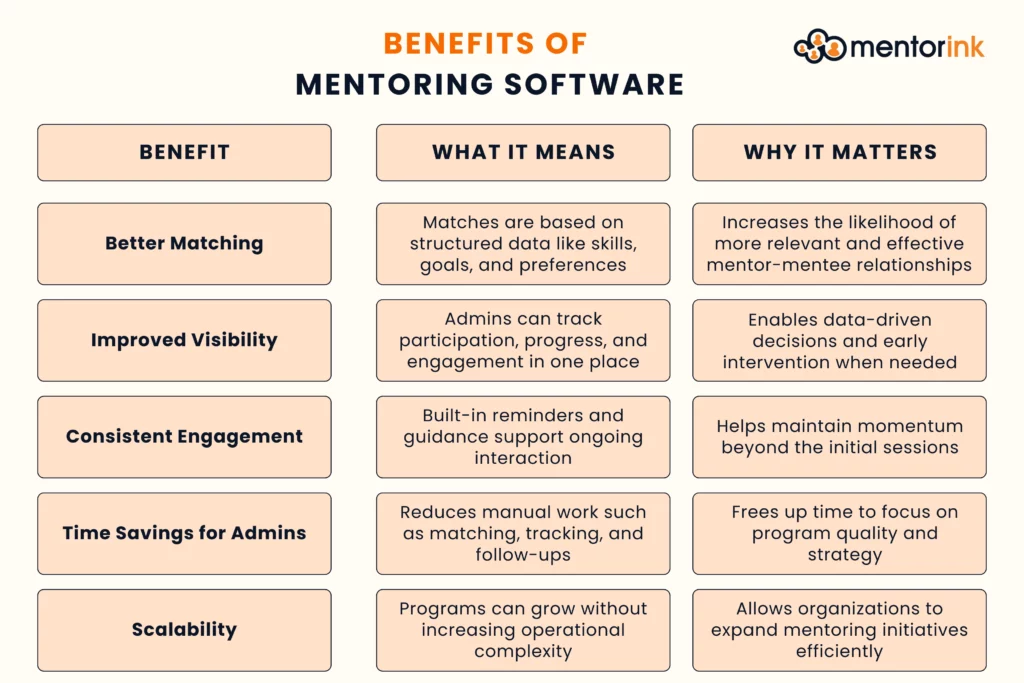
Overall, the advantages of mentoring software are not limited to making processes faster. They help create a more structured and sustainable mentoring experience, both for participants and for program owners.
Common Challenges of Mentoring Software
At this point, the benefits probably sound compelling. Mentoring software starts to look like a clear improvement over manual processes. But is it all smooth after that? Not exactly.
Like any system, mentoring software comes with its own challenges. The difference is that most of them don’t appear immediately, they show up over time, as the program starts to evolve.
The good news is that these challenges are not only common, but also manageable when approached correctly. Let’s take a closer look at the challenges of mentoring software, along with practical ways to address them.
Getting Buy-in from Stakeholders
One of the first challenges often appears before the software is even implemented.
Getting buy-in from key stakeholders, especially executives, can take time. In many organizations, mentoring already exists in some form, which makes it harder to justify investing in a dedicated platform. Questions around ROI, impact, and necessity are common.
Solution:
Reframe the conversation around impact, efficiency, and scalability. Instead of presenting mentoring software as a new cost, position it as a way to:
- Save time for program admins by reducing manual work (matching, tracking, follow-ups)
- Make the mentoring program more effective through better matching and structured processes
- Increase visibility with measurable data and reporting
- Scale the program without increasing operational complexity
Starting with a pilot program or a smaller rollout can also help demonstrate these benefits early and build confidence internally.
Learning and Adopting a New Tool
Another common concern is the introduction of a new platform.
For many participants, mentoring software can feel like just another tool to learn. If the onboarding process is unclear or the platform feels complex, this can create resistance and slow down adoption.
Solution:
Focus on simplicity and onboarding. To reduce resistance and improve adoption:
- Provide short, clear onboarding sessions to help users get started quickly
- Offer simple tutorials or guides that explain key actions step by step
- Choose a platform with intuitive navigation and minimal learning curve
- Make it easy for participants to take their first action (e.g., scheduling the first meeting)
The easier it is for participants to get started, the more likely they are to continue using the platform consistently.
Choosing the Right Tool
With many options available, selecting the right mentoring software can feel overwhelming.
Different platforms highlight different features, and it is easy to get lost in comparisons without a clear framework. This often leads to choosing a tool based on features rather than actual needs.
Solution:
Start with your program, not the tool. Define your goals, participant needs, and success criteria first. Then evaluate platforms based on how well they support those needs, rather than how many features they offer.
- Clarify what success looks like for your mentoring program before comparing tools
- Focus on platforms that align with your structure, not just feature lists
- Prioritize ease of use and adoption, not complexity
- Look for solutions that guide the program, not just manage it
Platforms like Mentorink are designed with this approach in mind, helping organizations build structured, scalable mentoring programs without unnecessary complexity.
Integration with Existing Systems
As mentoring programs become more structured, integration becomes an important consideration.
Most organizations already rely on multiple systems for HR, learning, and communication. If mentoring software does not connect well with these systems, it can create extra work and reduce efficiency.
Solution:
Plan integration early and make sure the platform fits into your existing ecosystem:
- Confirm whether these integrations are native or require additional setup
- Check if the platform can easily fit into your current workflows
- Involve your IT team early to avoid delays during implementation
Ensuring a smooth connection between systems helps mentoring become part of the existing workflow, rather than a separate process.
Quick Tip:
Ask for a clear list of platforms the software already integrates with (HRIS, LMS, SSO, etc.)
Final Thoughts on Using Mentoring Software
The benefits of mentoring software are clear, especially when it comes to improving structure, visibility, and scalability. At the same time, the challenges are just as real, particularly around adoption, alignment, and integration.
What makes the difference is not just the tool itself, but how well it fits the program and the organization behind it.
When mentoring software is aligned with clear goals, supported with the right structure, and integrated into existing workflows, it becomes much more than a system. It becomes a way to run mentoring programs more effectively and sustainably.
This is exactly where platforms like Mentorink come in, helping organizations not only launch mentoring programs, but also manage, scale, and continuously improve them over time.