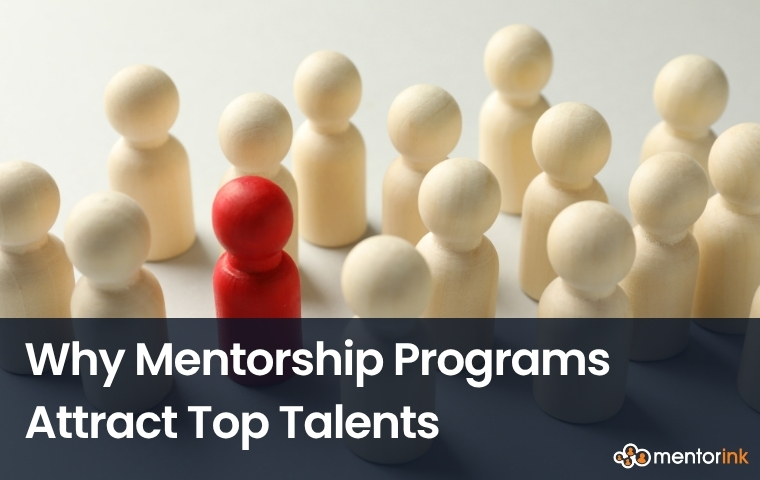
Attracting top talent today is harder than ever. Higher salaries, endless benefits, and companies constantly competing for the same people… It’s no surprise that many organizations choose to grow talent internally instead. It feels easier. More controllable. But it’s also a bit risky. Because attracting top talent might not be as difficult as it seems.
Top talent is already aware of their value. They know what they bring to the table and actively look for ways to grow even further. They don’t just want to learn. They want to be guided today and become the ones who guide others tomorrow. According to LinkedIn (2024), 7 in 10 people say learning improves their sense of connection to their organization. And one of the most effective ways to enable continuous learning is mentorship.
So instead of asking, “How do we compete for talent?” maybe the better question is: How can mentorship programs make talent choose you in the first place?
Top Talent Is Looking for Growth, Not Just a Job
Top talent today is not simply evaluating open roles or comparing salary ranges. They are trying to understand what kind of environment they are stepping into and whether that environment will support their long-term development.
In a market where opportunities are abundant, candidates have become much more selective. They are not only asking what the role offers today, but also what it enables for tomorrow. Will this role help me grow? Will I be exposed to the right people? Will I be challenged in a way that pushes me forward? These questions are no longer secondary. In many cases, they are the deciding factor.
What makes this even more important is that top talent is already aware of their own value. They know what they bring to the table and they are intentional about where they invest their time and energy. They are not just looking to perform well in their current role, but to continuously evolve.
This is where many companies struggle. They offer growth, but they fail to make it visible, structured, and accessible. As a result, candidates are left with uncertainty, and uncertainty rarely attracts high-potential individuals.
Mentorship, in this context, becomes more than a development tool. It becomes a way to signal that growth is not left to chance, but actively supported within the organization.
What Mentorship Signals to Candidates
Mentorship programs are often positioned as internal development initiatives. But from a candidate’s perspective, they communicate something much broader. They offer a glimpse into how a company actually approaches growth.
When candidates evaluate an organization, they are not only looking at what is offered, but also how it is experienced. Is development something employees are expected to figure out on their own, or is it actively supported? Are learning opportunities consistent, or dependent on individual effort? Mentorship makes these answers visible.
Without long explanations, it shows whether growth is structured, whether access is possible, and whether development is part of the everyday experience. For candidates, these signals help reduce uncertainty and make it easier to understand what kind of environment they are stepping into.
Growth is structured, not left to chance
One of the biggest questions top talent asks is simple: “How will I grow here?” Many companies struggle to give a clear answer. Growth is often mentioned, but rarely explained. It is left to individual effort, visibility, or timing. Mentorship changes this dynamic.
It introduces structure into development and makes growth more visible and consistent. Instead of leaving it to chance, companies create a system where employees are supported throughout their journey. This typically includes:
- Clear learning paths supported by experienced mentors
- Regular 1:1 conversations instead of reactive feedback
- Guidance tied to real challenges, not generic advice
For candidates, this makes a significant difference. Structured growth feels more reliable and shows that development is actively supported, not left to individual effort.
Access to experience is intentional
In many organizations, access to experienced professionals is limited. Employees are expected to learn by observing, asking at the right moment, or simply figuring things out over time. While this can work, it often slows down development and creates uncertainty, especially for early-career talent. Mentorship changes how access works.
It creates a space where conversations with more experienced professionals are not left to chance, but designed as part of the employee experience. Instead of waiting for the right opportunity, employees are given direct and consistent access to guidance. In reality, this looks like:
- Dedicated time with mentors who have relevant experience
- A safe space to ask questions and discuss challenges
- Exposure to different perspectives and ways of thinking
This kind of access shortens the learning curve, builds confidence, and makes it easier to navigate complex decisions early in a career.
Development is a shared responsibility
Not all organizations approach development in the same way. In some, growth depends heavily on the individual. Employees are expected to figure things out, find the right people, and create their own opportunities over time. While this can work for some, it often leads to uneven experiences across teams.
Mentorship introduces a different approach. It creates an environment where development is not carried alone, but supported through ongoing interaction. Learning becomes something that happens between people, not just within individuals. In practice, this becomes visible through:
- More open knowledge sharing across teams and roles
- A stronger feedback culture built on regular conversations
- Employees feeling more comfortable asking questions and seeking guidance
- Growth becoming a visible and shared priority across the organization
Over time, this shifts how people experience development. It feels less like a personal challenge to solve alone, and more like a collective effort that is supported and sustained.
Learning is part of the work, not separate from it
Learning does not always happen when it is scheduled. Most of the time, it happens in the middle of real work. While solving a problem, making a decision, or navigating something unfamiliar. This is where development becomes most meaningful.
Mentorship builds on this. It brings learning into everyday moments instead of placing it outside of them. Conversations are not abstract or theoretical, but directly connected to what employees are experiencing in their roles. You can see this in how mentorship naturally operates:
- Discussions are shaped around real tasks and ongoing challenges
- Feedback is immediate and tied to actual decisions
- Knowledge is shared within context, not as general advice
- Employees apply what they learn right away
This makes learning feel more continuous and less forced. It becomes part of how work happens, not something employees have to step away to do.
Why This Matters in Hiring Decisions
Up to this point, mentorship may seem like an internal initiative focused on development. However, its impact goes far beyond employee experience. It directly shapes how candidates perceive your organization and influences their decision-making process.
When candidates evaluate multiple opportunities, they are not only comparing roles but also trying to reduce uncertainty. They want to understand what their experience will look like after they join, how they will grow, and whether they will be supported along the way. This is where mentorship becomes a differentiating factor.
It reduces uncertainty for candidates
One of the biggest challenges in hiring is not attracting candidates, but giving them enough clarity to choose you with confidence. Job descriptions, interviews, and employer branding can only go so far in explaining what it is like to work at a company. There is always a gap between what is said and what is experienced.
Mentorship helps close that gap. It makes the experience of growth more tangible by showing how support, guidance, and development actually happen within the organization. Instead of relying on assumptions, candidates can better understand what kind of environment they are stepping into and how they will navigate it.
It makes growth visible and believable
Growth is one of the most commonly used promises in hiring. Almost every company claims to offer development opportunities, learning environments, and career progression. However, for candidates, these statements often feel abstract and difficult to evaluate.
What makes the difference is not the promise itself, but how clearly it is supported.
Mentorship makes growth visible in a concrete way. It shows that development is not dependent on chance, but supported through real interactions and ongoing guidance. Candidates can see how learning happens, who supports it, and how it is integrated into the employee experience.
This shifts growth from being a vague idea to something more believable. It becomes easier for candidates to trust that what is being offered is not just part of employer branding, but an actual part of how the organization operates.
It strengthens early commitment
The hiring process does not end when a candidate accepts an offer. In many cases, the real decision continues even after joining. Early experiences within the company play a critical role in shaping engagement, motivation, and long-term commitment.
Mentorship helps create a stronger start.
It provides new employees with immediate access to guidance and support, helping them navigate their roles more confidently from the beginning. Instead of feeling disconnected or uncertain, they are more likely to feel supported and integrated into the organization.
This early sense of connection can significantly influence how employees perceive their decision to join. It builds trust, accelerates adaptation, and increases the likelihood of long-term engagement.
Mentorship as a competitive advantage
In a competitive talent market, most companies focus on what they can offer on the surface. Salary, benefits, flexibility, and titles often become the main points of differentiation. While these factors are important, they are also easy to replicate.
What is harder to replicate is how a company enables growth.
Mentorship creates an advantage that goes beyond standard offerings. It reflects how people are supported, how knowledge is shared, and how development is embedded into everyday work. Over time, this becomes part of how the organization is perceived, both internally and externally.
This advantage becomes visible in several ways:
- Candidates see a clearer and more structured path for growth
- The company stands out beyond compensation and benefits
- Employee experience becomes more consistent across teams
- Stronger internal connections improve retention and engagement
- The organization builds a reputation for investing in people
Rather than competing on what is offered, companies begin to differentiate through how growth is experienced. And for top talent, this difference is often what makes the final decision.
Final Thoughts
Attracting top talent is no longer just about offering opportunities. It is about making those opportunities visible, structured, and real.
Mentorship plays a key role in this.
It shows how a company supports growth, how people learn from each other, and how development is embedded into everyday work. Instead of relying on promises, it creates an experience candidates can recognize and trust.
In a market where talent has options, this clarity matters.
Because the companies that stand out are not the ones that offer more, but the ones that make growth feel possible from the very beginning.