
Today’s workplaces are undergoing rapid transformation. Skills are evolving faster than traditional training can keep up, hybrid work has reshaped how teams connect, and, for the first time in history, five different generations are working together. Yet despite this diversity and experience, Gallup reports that only 21% of employees feel engaged at work.
This gap is not only about skills. It is about connection, conversation, and continuous support.
As expectations, communication styles, and motivations shift across generations, companies need a structured way for people to learn from each other. This is why workplace mentoring programs have become one of the most reliable and scalable tools for strengthening culture, developing talent, and supporting employees at every stage of their careers.
In this article, we’ll explore what workplace mentoring program is, why organizations invest in it, the benefits it delivers, and how companies can successfully engage employees in mentoring initiatives.
What Is a Workplace Mentoring Program?
A workplace mentoring program is a structured, goal-oriented development initiative that connects employees for meaningful learning, support, and knowledge exchange. Instead of relying solely on formal training, mentoring helps people grow through conversation, shared experiences, and practical guidance. At its core, it brings together individuals with different skills, backgrounds, and perspectives so they can learn from one another in a focused and impactful way.
While traditional mentoring pairs a more experienced employee with someone earlier in their career, modern workplace mentoring programs take many forms and serve a wide range of strategic goals. Organizations use mentoring to support new hires during onboarding, accelerate leadership development, strengthen diversity and inclusion initiatives, and improve collaboration across teams and departments. No matter the format, the purpose remains the same: to create a workplace where employees can develop skills, feel supported, and build the relationships they need to succeed.
Common Types of Mentoring Programs in the Workplace
Organizations use several mentoring formats depending on their goals, workforce structure, and development priorities. Each format supports learning in a different way and can be adapted to fit various teams, roles, and cultures:
• One-to-one mentoring: A classic pairing model where one mentor guides one mentee.
• Group mentoring: Small groups learning together with one or more mentors.
• Peer mentoring: Colleagues at similar levels exchanging insights and support.
• Reverse mentoring: Junior employees sharing fresh perspectives with senior leaders.
• Flash or spot mentoring: Short, highly focused sessions that address immediate challenges.
Whether the goal is upskilling, fostering a sense of belonging, or strengthening leadership pipelines, a well-designed workplace mentoring program creates opportunities for employees to learn directly from lived experience. This human-centered approach is especially valuable in today’s workplace, where teams are diverse, distributed, and continuously adapting to change.
This is where the real value of mentoring becomes clear. Beyond helping individuals grow, mentoring equips organizations with practical solutions to the challenges shaping today’s workplace.
Why Companies Invest in Mentoring Programs
Companies do not invest in mentoring programs simply because they are popular. They invest because mentoring directly addresses some of the most urgent challenges in today’s workplace. Skills are evolving faster than traditional training programs can keep up, employee expectations are shifting, and organizations need development solutions that feel personal, practical, and scalable. Mentoring programs provide exactly that.
A strong mentoring culture helps organizations navigate talent shortages, strengthen leadership, and support employees through periods of change. It creates a space where people can ask questions, receive guidance, and build confidence in ways that formal learning environments often cannot deliver. As a result, mentoring becomes more than a development tool. It becomes a strategic advantage.
Below are the most common and impactful reasons why companies choose to invest in mentoring programs:
Addressing Skill Gaps and Future-Proofing Talent
- Closing capability gaps that training alone cannot fill
- Preserving institutional knowledge through real-world learning
Developing a Strong Leadership Pipeline
- Preparing emerging leaders with coaching, feedback, strategic exposure
- Supporting succession planning with more predictable talent readiness
Supporting Inclusion, Belonging, and Equity (DEI)
- Building cross-cultural understanding
- Connecting people across backgrounds and lived experiences
Accelerating Onboarding & Time-to-Productivity
- Helping new hires adapt faster through relational learning
- Reducing early-stage uncertainty and ramp-up friction
Strengthening Collaboration in Hybrid & Distributed Teams
- Creating intentional touchpoints where informal learning is missing
- Enhancing communication across teams and functions
These reasons explain why organizations turn to mentoring, but the true impact becomes even clearer when we look at the measurable advantages mentoring brings to overall performance and culture.
What Advantages and Benefits Can Companies Gain from Mentoring Programs?
While the decision to launch a mentoring program is often driven by talent needs, the true value emerges in the broader organizational impact. Mentoring enhances how teams operate, how decisions are made, and how quickly companies can adapt to change. These benefits extend far beyond employee development and directly strengthen organizational performance.
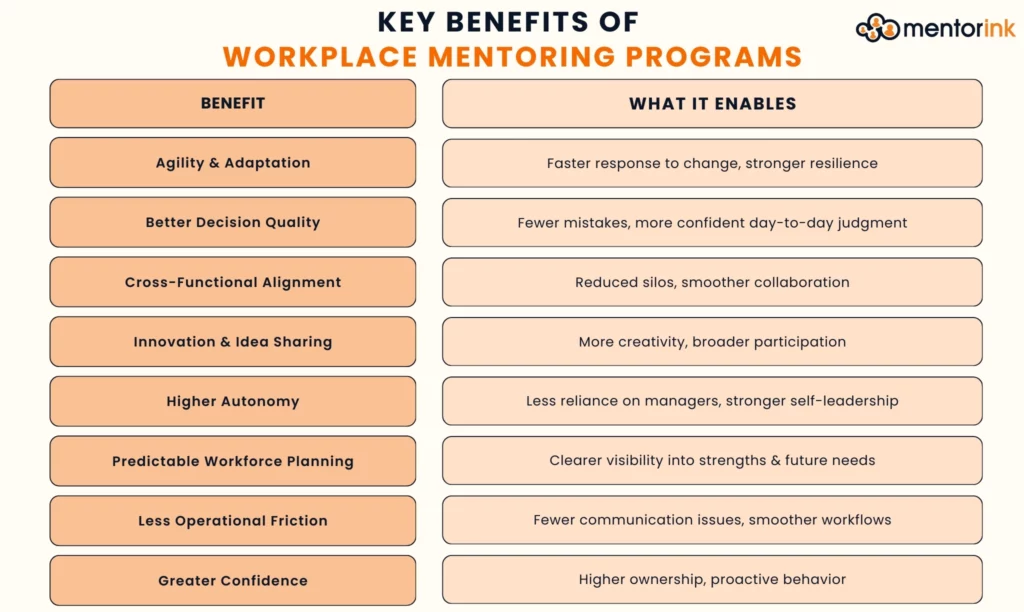
1. Stronger Organizational Agility and Faster Adaptation to Change
Mentoring accelerates how quickly a company can respond to new technologies, market shifts, or strategic priorities. Employees learn to navigate uncertainty with confidence, which makes the entire organization more flexible and better equipped to handle rapid transformation.
Impact:
- Faster response to new business needs
- Better adaptability during reorganizations or rebranding
- Higher resilience during industry disruption
2. More Consistent Decision Quality Across the Organization
When employees regularly discuss challenges with more experienced colleagues, the quality of everyday decision-making improves. This reduces unnecessary escalation, prevents avoidable mistakes, and creates a more reliable operational baseline.
Impact:
- Fewer workflow bottlenecks
- Increased accuracy in judgment-heavy roles
- More autonomy with less managerial overhead
3. Improved Cross-Functional Alignment and Operational Flow
Mentoring naturally breaks silos because people interact across teams and departments. This leads to smoother handovers, more aligned priorities, and clearer communication channels between different functions.
Impact:
- Better project coordination
- Fewer misunderstandings between teams
- More efficient cross-department execution
4. Enhanced Innovation Capacity Through Idea Sharing
When people have safe, structured conversations about challenges, new ideas emerge. Mentoring encourages experimentation, reflection, and fresh thinking, which supports innovation regardless of job title or seniority.
Impact:
- More creative problem solving
- More contributions from quiet or overlooked talent
- Healthier ideation pipelines for new initiatives
5. Greater Employee Autonomy and Reduced Managerial Load
Mentoring reduces unnecessary dependency on managers by giving employees an additional, trusted source of guidance. Managers spend less time on day-to-day coaching and more time on strategic responsibilities.
Impact:
- Increased managerial bandwidth
- More independent and confident employees
- Better distribution of leadership responsibilities
6. More Predictable Workforce Planning and Talent Stability
Through mentoring conversations, organizations gain clearer visibility into employees’ strengths, ambitions, and potential risks. This helps companies anticipate future capability needs and plan workforce transitions with more precision.
Impact:
- Better alignment between talent and business needs
- Early identification of critical-role successors
- More accurate long-term workforce strategy
7. Reduction in Operational Friction and Informal Communication Issues
Many workplace slowdowns happen not because people lack skill, but because they lack context. Mentoring gives employees the informal insights, unwritten rules, and relational understanding they need to work smoothly in the organization.
Impact:
- Fewer communication breakdowns
- More efficient workflows
- Reduced conflict between teams or roles
8. A Stronger Sense of Professional Confidence Across the Workforce
Employees who have a sounding board tend to take initiative more often and approach challenges with greater clarity. This confidence positively affects how teams interact, how they make progress, and how they show up in critical moments.
Impact:
- Higher ownership
- More proactive behavior
- Stronger performance in high-pressure situations
Understanding these benefits is only the first step. To unlock them consistently, companies need a mentoring program built on strong foundations and thoughtful design. Let’s take a closer look at the best practices that make workplace mentoring truly effective.
Best Practices for Designing Effective Workplace Mentoring Programs
Successful mentoring programs are built on a strong structure. A clear process, simple tools, and consistent support make it easier for employees to participate and get real value from the experience. Below are practical best practices that help organizations launch and sustain impactful mentoring initiatives.
- Define a clear purpose before launching
Strong programs begin with clarity. Decide what you want mentoring to achieve, who the program will serve, and how success will be measured. Clear goals ensure the program feels intentional, not generic.
- Select a mentoring format that fits your goals
Different needs require different structures. One-to-one mentoring offers deeper support, group circles scale learning effectively, and reverse mentoring strengthens generational exchange. Choose the format that makes sense for your workforce.
- Use a structured and transparent matching process
A good match sets the tone for the entire relationship. Use simple questionnaires to understand goals, strengths, and expectations. Communicate how the match is made so participants feel confident from the start.
- Prepare mentors and mentees with brief orientation
Short onboarding sessions help participants understand roles, boundaries, and meeting structures. Even experienced employees benefit from clear expectations and simple guidelines.
- Provide easy-to-use frameworks and conversation guides
Many mentoring pairs feel unsure about where to begin. Offer agenda templates, goal-setting tools, and conversation starters to help them stay focused and productive.
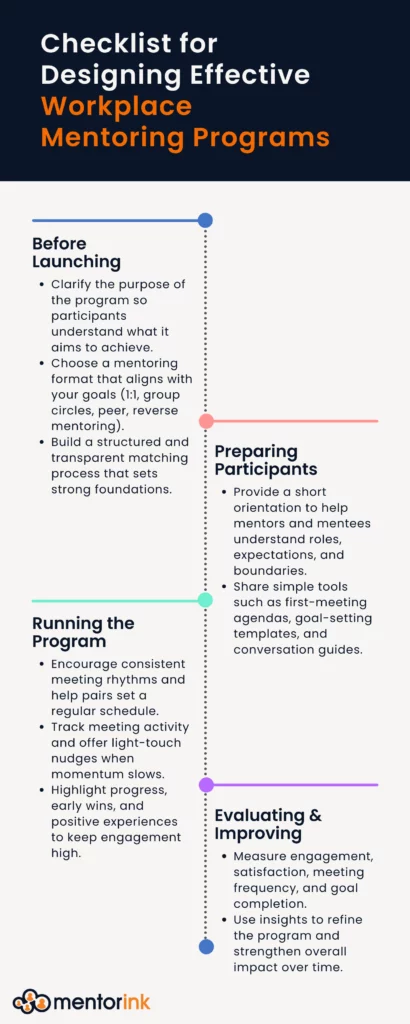
- Encourage consistent meeting rhythms
Mentoring relationships grow through regular contact. Recommend a meeting frequency and help participants set a schedule that works for them.
- Monitor participation and offer light-touch support
- Smart matching based on skills, goals, and interests
- Guided session flows with agendas and goal-setting tools
- Automated reminders to keep mentoring relationships active
- Built-in scheduling and messaging for smoother communication
- Real-time dashboards that show engagement and progress
- Flexible formats like peer, reverse, or leadership mentoring
- Effortless scalability as your program grows
Keep track of meeting activity and check in when momentum slows. Small nudges or guidance can prevent early drop-off and keep relationships on track.
- Share progress and highlight positive outcomes
Internal success stories, anonymized insights, and milestone updates help build excitement around the program and encourage ongoing participation.
- Measure results and refine the program over time
Track engagement, satisfaction, meeting frequency, and goal completion. These insights help you identify what works, what needs improvement, and how mentoring contributes to broader talent goals.
How Mentoring Software Can Help
Running a mentoring program manually can quickly become overwhelming. Matching, tracking, scheduling, and keeping people engaged takes time, and that’s where mentoring software makes all the difference.
Mentorink helps organizations build mentoring programs that are structured, scalable, and easy to manage.
Here’s how:
- Smart matching based on skills, goals, and interests
- Guided session flows with agendas and goal-setting tools
- Automated reminders to keep mentoring relationships active
- Built-in scheduling and messaging for smoother communication
- Real-time dashboards that show engagement and progress
- Flexible formats like peer, reverse, or leadership mentoring
- Effortless scalability as your program grows
With Mentorink, mentoring becomes simple, measurable, and impactful, not just another initiative. It gives HR and L&D teams the clarity and support they need, while making the experience meaningful for every mentor and mentee.
Wherever you are in your mentoring journey, Mentorink helps you move forward with confidence.
Key Takeaways
Workplace mentoring programs help organizations navigate today’s complexities by strengthening skills, relationships, and culture. When mentoring is intentional and well-structured, it improves retention, accelerates development, and creates more connected, confident teams.
The most effective programs bring clarity (a defined purpose), alignment (the right mentoring format), and consistency (ongoing support for mentors and mentees). With these foundations in place, mentoring becomes a sustainable way for employees to learn from each other, adapt to change, and grow in meaningful ways.
Ultimately, mentoring is not just a development tool, it’s a strategic investment in people and the future of the organization.