You learn the job, get comfortable with it and finally feel like you know what you’re doing. Then a new tool arrives, responsibilities change or AI casually learns how to do part of your Tuesday afternoon.
Work changes. Skills have to change with it.
That is where upskilling and reskilling come in. As LinkedIn Learning explains, upskilling builds on existing skills, while reskilling focuses on developing new ones for a different role.
They may sound like two HR terms competing for space in the same slide, but the difference is useful. One helps people get better at what they do. The other helps them prepare to do something different.
What Is Upskilling?
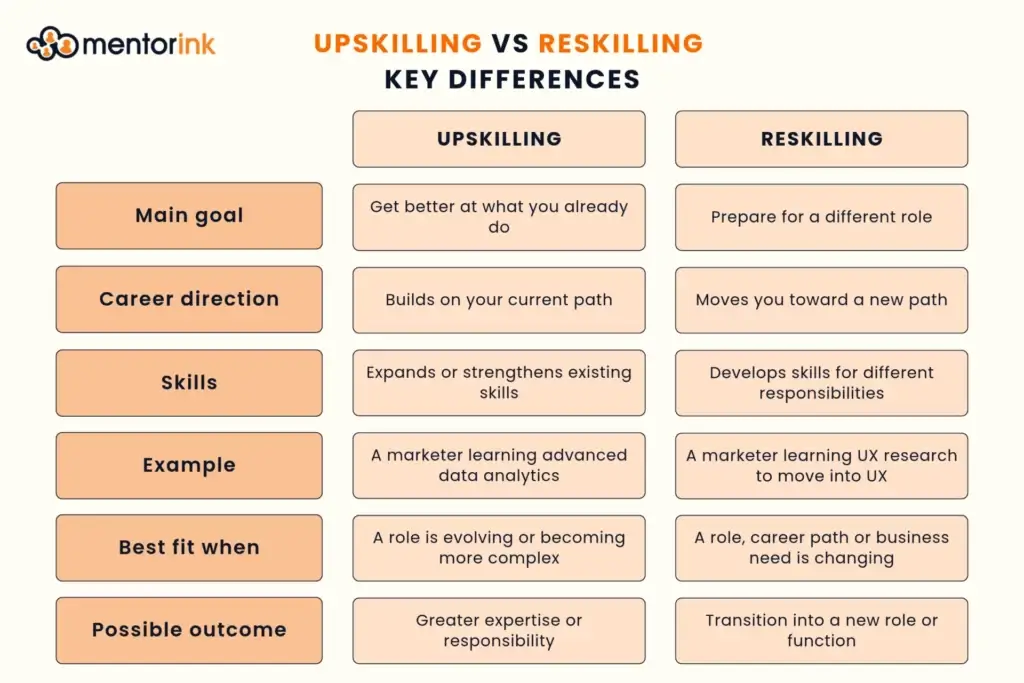
Upskilling means developing new or stronger skills that help you perform better in your current role or progress along the same career path.
Think of a marketer learning data analytics, a manager improving their coaching skills or a developer learning a new framework. They are not starting over. They are adding to what they already know.
Upskilling can happen through courses, hands-on projects, mentoring, peer learning, job shadowing or new responsibilities. What matters is having an opportunity to actually apply those new skills.
What Is Reskilling?
Reskilling means learning a new set of skills to move into a different role.
A customer support specialist moving into customer success, for example, may already have communication and problem-solving skills but need to develop new capabilities in account management and customer retention.
For organizations, reskilling can help fill changing skill needs without always looking outside the company. And for employees, it does not necessarily mean starting from zero. Existing experience and transferable skills can still come along for the ride.
What Is the Difference Between Upskilling and Reskilling?
The main difference between upskilling and reskilling is where the learning is meant to take you.
With upskilling, the direction stays broadly the same. You develop skills that help you grow in your current role or career path. Reskilling involves a bigger change in direction, with new skills preparing you for a different role.
Neither is better than the other. Sometimes people need new skills to keep growing where they are. Sometimes their next opportunity is somewhere else.
Upskilling and Reskilling Examples
The difference is simple enough on paper, but real career paths are rarely that tidy. A few workplace examples can make it much easier to see when someone is building on their existing skills and when they are preparing for something new.
Upskilling Examples
- A sales representative learns advanced negotiation techniques to handle larger accounts.
- A team leader develops coaching skills to prepare for managing a larger team.
- A software developer learns a new framework relevant to their work.
- An HR professional develops people analytics skills to make better use of workforce data.
Reskilling Examples
- A customer support specialist learns account management skills to move into customer success.
- An administrative employee develops data analysis skills to transition into a junior analyst role.
- A recruiter develops employer branding skills to move into an employer branding position.
- A production worker learns to operate automated systems as technology changes their work.
The difference is the destination: upskilling builds on an existing path, while reskilling prepares someone for a new one.
Benefits of Upskilling and Reskilling
People gain new skills, companies get the skills they need. Sounds like a pretty good deal.
Upskilling and reskilling can help organizations close skill gaps, support career development, improve retention and create more internal mobility. Instead of treating external hiring as the answer to every new skill need, companies can develop more of the talent they already have.
They can also make teams more adaptable. Job descriptions change, new technology arrives and business priorities have a habit of refusing to stay put. Employees who are comfortable learning and applying new skills are better prepared when they do.
How Mentoring Supports Upskilling and Reskilling
Learning a skill is one thing. Knowing how to use it when a real problem lands on your desk is another.
Mentoring can help bridge that gap. Someone who is upskilling can get feedback and learn how experienced colleagues approach real situations. Someone who is reskilling can learn directly from a person who already understands the role they are moving into.
Courses and workshops can teach the theory. Having someone to ask, “Am I doing this right?” can make applying it considerably easier than watching another progress bar reach 100%.
With Mentorink, organizations can make mentoring part of employee development at scale, connecting people with the right mentors and supporting their learning throughout the journey.
FAQs About Upskilling and Reskilling
Can you upskill and reskill at the same time?
Yes. The line between the two is not always perfectly neat. Someone moving into a new role may need to learn completely new skills while also strengthening skills they already have. What matters is whether the development mainly supports growth in the current direction or prepares the person for a different one.
How do you know when to upskill or reskill an employee?
Start with where the gap is. If the role still makes sense but the skills required to do it are changing, upskilling may be enough. If the role is disappearing, changing significantly or the employee is moving into a different area, reskilling may make more sense.
Does upskilling always lead to a promotion?
Not necessarily, and that is not the only reason to do it. Upskilling can help someone become better at their current job, take on more complex work, prepare for future opportunities or simply keep pace as their role evolves. A new job title is nice, but it is not the only sign that learning paid off.
Final Thoughts
Skills have a shorter shelf life than they used to. That does not mean everyone needs to reinvent their career every six months.
Sometimes people need the chance to get better at what they already do. Sometimes they are ready, or the business needs them, to move in a new direction. Upskilling and reskilling give organizations a way to support both.
The important part is making development useful beyond the course, workshop or certificate. Give people opportunities to practise what they learn, connect them with people they can learn from and create somewhere for those new skills to take them.
Because collecting skills is nice. Getting to use them is much better.