
Job shadowing sounds simple: follow someone around for a day and see what they do.
And, well… yes. That is part of it.
But a good job shadowing experience can do much more than give someone a peek at another person’s calendar. It can help employees understand what a role really looks like, explore new career paths, learn how other teams work and pick up the kind of practical knowledge that rarely makes it into a training deck.
That is why job shadowing can be useful far beyond onboarding or early-career development. A new hire might shadow an experienced teammate to understand the role faster. Someone considering an internal move might spend time with another department before making the jump. A future manager might shadow a senior leader to see how decisions, conversations and priorities are handled in real life.
For organizations, that makes job shadowing a relatively simple way to support learning, knowledge sharing, internal mobility and cross-functional collaboration.
So, what exactly is job shadowing, how does it work, and what separates a useful experience from an awkward day of silently following someone from meeting to meeting?
What is Job Shadowing?
Job shadowing is a workplace learning method where one person observes another employee during their day-to-day work to better understand the role, responsibilities, skills and workflows involved.
The job shadowing definition is essentially learning by seeing a job in action. A shadow may join meetings, observe tasks, ask questions and see how decisions are made in real work situations.
A job shadow can last a few hours, a full day or several sessions, depending on what the employee wants to learn.
Key Elements of Job Shadowing
While every job shadowing experience can look a little different, a few elements usually make it work:
- Observation: The shadow sees how the role, tasks and responsibilities work in real situations.
- Interaction: They can ask questions and discuss what they observe with the host.
- Real-world learning: The focus is on seeing skills, workflows and decision-making in practice rather than learning them only through formal training.
- Clear learning goals: The experience works best when the participant knows what they want to understand or explore.
What Does Shadowing Mean in a Job?
Shadowing in a job means spending time with another employee to observe how they work, ask questions and learn from their experience.
Rather than taking over the role, the shadow gets a firsthand look at how tasks, decisions and everyday challenges are handled in practice.
How Does Job Shadowing Work?
Job shadowing usually starts with a clear goal. The employee may want to understand a different role, explore a possible career move, learn how another team works or prepare for new responsibilities.
From there, the process is fairly simple:
- Set the learning goal: Decide what the shadow wants to understand or take away from the experience.
- Choose the right host: Match the employee with someone whose role, experience or expertise fits that goal.
- Plan the session: Agree on the timing, activities, meetings and workflows that will be useful to observe.
- Observe and ask questions: The shadow follows the host’s work, takes notes and asks questions along the way.
- Reflect afterwards: A short follow-up conversation can help turn observations into practical takeaways.
A job shadow can last a few hours, a full working day or several sessions, depending on the role and the participant’s learning goals.
Do You Get Paid for Job Shadowing?
Whether job shadowing is paid depends on the type of arrangement.
For existing employees, job shadowing often takes place during regular working hours as part of onboarding, career development or internal learning, so they would typically continue to receive their usual pay.
For students, job candidates or external participants, the arrangement may be unpaid if they are only observing. If the shadow is expected to carry out actual work, different employment rules may apply depending on the country and local regulations.
Benefits of Job Shadowing
Job shadowing gives employees something traditional training cannot always provide: a real look at how work happens.
By observing experienced colleagues, employees can better understand different roles, learn how skills are applied in practice and discover career paths they may not have considered before.
Benefits of Job Shadowing for Employees
For employees, job shadowing can provide:
- A clearer understanding of different roles: Employees can see what a job actually involves before considering a career move or taking on new responsibilities.
- Practical skill development: Watching experienced colleagues can reveal how they communicate, solve problems, prioritize and make decisions.
- Career exploration: A job shadow gives employees a low-risk way to explore another role, department or career path.
- A broader internal network: Shadowing creates opportunities to meet and learn from colleagues outside an employee’s usual team.
- Greater confidence: Seeing how a role works in practice can make future responsibilities feel more familiar and achievable.
Benefits of Job Shadowing for Organizations
For organizations, the benefits can go beyond individual learning:
- Knowledge transfer: Experienced employees can share practical knowledge that might otherwise stay within one person or team.
- Internal mobility: Employees can explore opportunities within the organization before making a move.
- Cross-functional collaboration: Understanding how other teams work can improve communication and reduce silos.
- Leadership development: Future managers and leaders can gain exposure to how experienced leaders work and make decisions.
- Employee engagement: Giving people more ways to learn and explore their careers can make development feel more relevant and personal.
- Faster onboarding: New employees can understand workflows, expectations and team dynamics more quickly by observing experienced colleagues.
Research from the Institute for Corporate Productivity (i4cp) has also linked job shadowing with better organizational understanding, skill development, succession planning and employee retention.
Job Shadowing Examples
Job shadowing can look very different depending on the employee’s goal. It does not always mean spending an entire day following someone from meeting to meeting.
Here are a few common examples:
- Leadership Job Shadowing: An employee preparing for a management role might shadow an experienced leader to see how they run meetings, make decisions, give feedback and manage priorities.
- Cross-Department Job Shadowing: An employee from one team can shadow someone in another department to understand how their work connects. For example, someone in marketing might spend time with sales or customer success to better understand customer conversations and needs.
- New Hire Job Shadowing: A new employee can shadow an experienced teammate during onboarding to learn workflows, expectations and day-to-day ways of working more quickly.
- Career Exploration Job Shadowing: Employees considering an internal move can use job shadowing to explore another role before applying. It gives them a more realistic understanding of the responsibilities, skills and challenges involved.
- Project-Based Job Shadowing: A job shadow can also focus on a specific activity rather than an entire role. An employee might observe a client meeting, planning session, presentation or other task they want to learn more about.
Job Shadowing vs. Mentoring
Job shadowing and mentoring can both support employee development, but they work in different ways.
Job shadowing is mainly about learning through observation. The shadow watches how another person works, asks questions and gains a practical understanding of a role or skill.
Mentoring is usually more focused on ongoing guidance and development. A mentor supports the mentee through conversations, feedback, reflection and advice over a longer period of time.
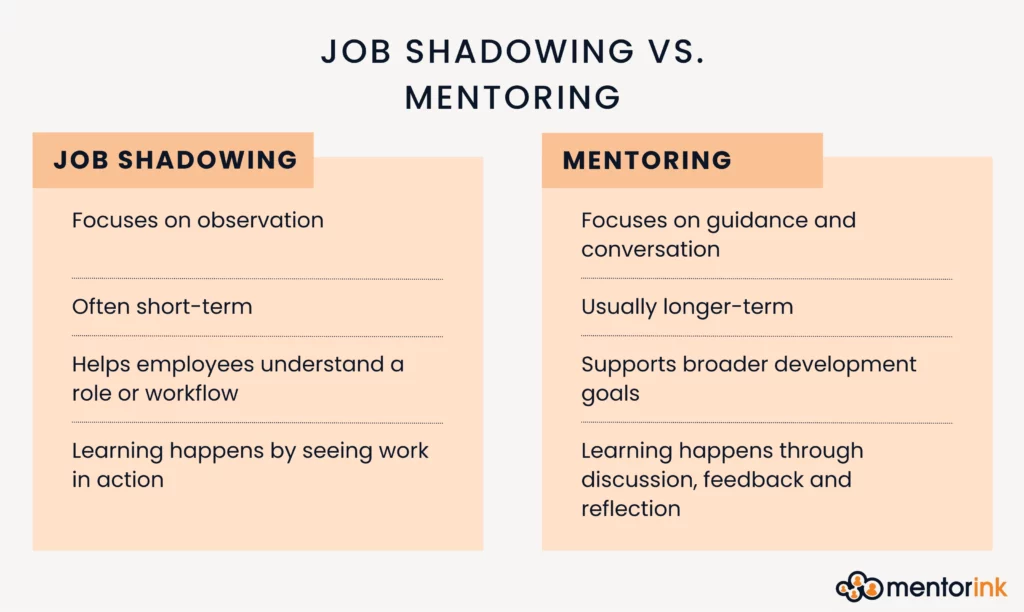
The two can also work well together. For example, a mentor might invite a mentee to shadow an important meeting or project so they can see a skill or responsibility in practice.
Job shadowing does not replace mentoring. It can add another layer of real-world learning to the development experience.
Job Shadowing vs. On-the-Job Training
Job shadowing and on-the-job training both happen in real work environments, but they serve different purposes.
In job shadowing, the employee mainly observes how a role, task or workflow is handled. The focus is on understanding the work before taking responsibility for it.
On-the-job training is more hands-on. Employees actively perform tasks while receiving guidance, feedback and support from a more experienced colleague.
A useful way to think about the difference is this: job shadowing gives employees a chance to see the work in action, while on-the-job training helps them practice doing it themselves.
Build a Successful Job Shadowing Program
A successful job shadowing program does not need to be complicated. What matters is giving both the shadow and the host enough structure to make the experience useful.
- Define your goals: Decide what the program should support, such as onboarding, internal mobility, leadership development, career exploration or knowledge transfer.
- Choose the right participants: Identify the roles, teams and employees that would benefit most from job shadowing.
- Make thoughtful matches: Pair shadows with hosts based on learning goals, skills, experience, career interests and availability.
- Set expectations: Make sure both sides understand the purpose, schedule, activities and boundaries of the experience.
- Prepare participants: Encourage shadows to prepare questions and hosts to choose useful tasks, meetings or workflows to observe.
- Keep it structured: Include time for observation, questions and a short discussion or reflection afterwards.
- Collect feedback: Ask both shadows and hosts what worked, what they learned and what could be improved.
- Track the results: Look at participation, satisfaction, learning outcomes and, where relevant, internal mobility or career development over time.
A little structure can turn job shadowing from “come sit with me for a day” into a much more meaningful learning experience.
How Technology Can Support Job Shadowing Programs
As a job shadowing program grows, managing participants, matches, schedules and feedback manually can become difficult.
Technology can help organizations keep the process organized by supporting:
- Participant applications and profiles
- Matching shadows with the right hosts
- Scheduling and reminders
- Communication between participants
- Feedback collection
- Program tracking and reporting
This makes it easier to run job shadowing at scale while keeping the experience structured and consistent for everyone involved.
With Mentorink, organizations can manage participants, matching, communication, reminders, feedback and reporting in one place, making it easier to build and scale structured development programs.
If you are planning a job shadowing, mentoring or broader employee development program, you can explore how Mentorink can support the process from matching to measurement.
Common Job Shadowing Mistakes to Avoid
Even a well-intentioned job shadow can fall flat if the experience is too passive, too broad or disconnected from the employee’s actual development needs.
Some common mistakes include:
- Treating job shadowing as passive observation: Watching someone work without context or interaction can quickly become unproductive.
- Trying to show too much in one session: Filling the day with back-to-back meetings can leave the shadow with plenty of information but very little real understanding.
- Focusing only on visible tasks: Some of the most valuable learning comes from understanding why decisions are made, not just seeing what happens.
- Ignoring confidentiality or sensitive situations: Not every meeting, conversation or workflow will be appropriate for a shadow to observe.
- Using job shadowing as a one-size-fits-all solution: Some development goals are better supported through mentoring, coaching, formal training or hands-on practice.
- Limiting opportunities to informal networks: If employees can only access job shadowing through people they already know, the program may unintentionally exclude others from valuable development opportunities.
The goal is not simply to give employees more exposure. It is to make that exposure relevant, intentional and useful.
Final Thoughts
Job shadowing works because it brings learning closer to the work itself. With the right goals, thoughtful matches and enough structure, it can support everything from onboarding and career exploration to knowledge transfer and internal mobility.
And sometimes, seeing how a job actually works can teach employees more than another slide deck ever could.The goal is not simply to give employees more exposure. It is to make that exposure relevant, intentional and useful.